
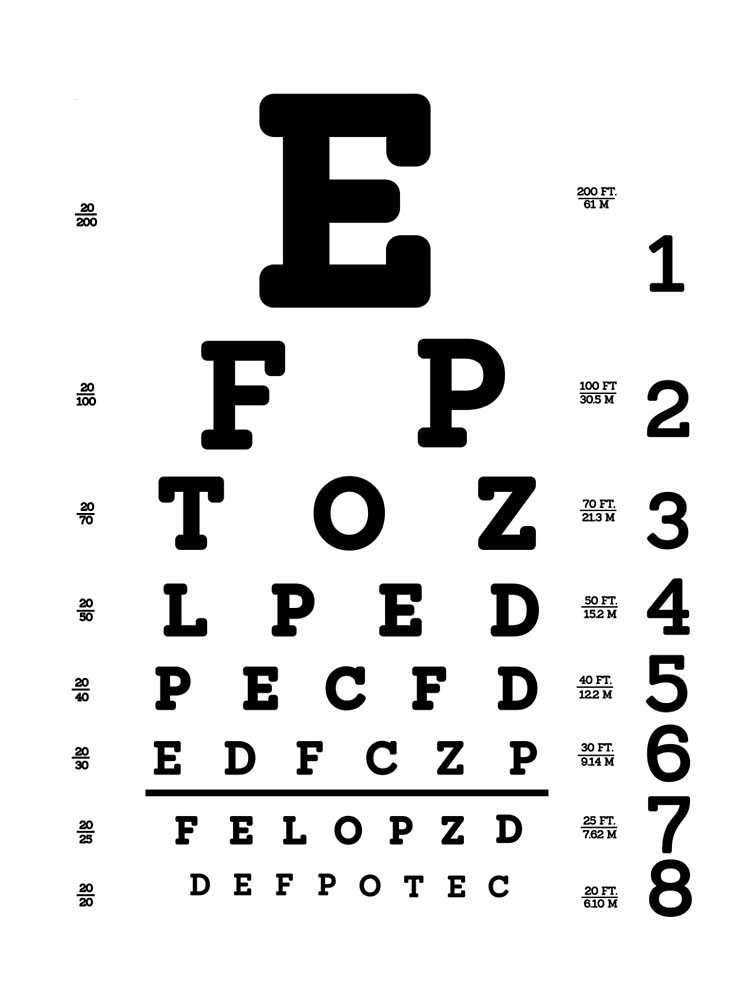
Ever squint at a road sign, thinking it’s just a fleeting moment of blurry vision? What if that fuzziness is telling you something more – that your visual acuity might be a notch below the gold standard? Let’s delve into the specifics of 20/25 vision, exploring what it signifies and how it impacts your day-to-day life.
Deciphering the Code: The Snellen Chart and Visual Acuity
The ubiquitous Snellen chart, with its descending rows of letters, is the cornerstone of vision assessment. This chart, standardized for distance and letter size, provides the benchmark for evaluating visual acuity. The designation “20/20” represents the distance at which a person with normal vision can read a particular line on the chart (20 feet) relative to the distance at which *you* can read the same line. Thus, 20/20 is the common benchmark.
Unpacking 20/25 Vision: A Slight Detour from Perfection
Now, let’s translate what 20/25 vision actually means. If your vision is 20/25, it means that you can see at 20 feet what a person with normal (20/20) vision can see at 25 feet. In essence, you need to be closer to an object to see it as clearly as someone with standard vision. It indicates a minor refractive error, often readily correctable.
The Refractive Culprits: Understanding the Underlying Causes
Several refractive errors can contribute to 20/25 vision. Myopia (nearsightedness) occurs when the eye focuses light in front of the retina, causing distant objects to appear blurry. Hyperopia (farsightedness) results from the eye focusing light behind the retina, leading to blurry vision for close objects, and sometimes even distant ones. Astigmatism, an imperfection in the curvature of the cornea or lens, can also cause blurry or distorted vision at all distances.
Life with 20/25 Vision: Navigating the Nuances
While 20/25 vision is generally considered relatively mild, it can still have a noticeable impact on certain activities. Driving, especially at night, might require extra concentration. Reading street signs or recognizing faces from a distance could pose a challenge. For students, viewing the whiteboard or projector screen could become slightly strained. The crucial point is the individual’s experience; some individuals with 20/25 vision may experience no noticeable difficulties, while others find it significantly impacts their daily routines.
Do You Need Corrective Lenses? A Confluence of Factors
The decision to pursue corrective lenses or other vision correction options depends on a constellation of factors. The degree of visual impairment, the specific activities impacted, and the individual’s personal preferences all play a crucial role. An ophthalmologist or optometrist can conduct a comprehensive eye exam to determine the underlying cause of the refractive error and recommend the most appropriate course of action. Furthermore, evaluating binocular vision skills is crucial. Efficient eye teaming and focusing are vital for overall visual comfort and performance. Dysfunction in these areas, even with good visual acuity, can cause eye strain, headaches, and reading difficulties.
The Correction Arsenal: Options for Sharper Sight
Fortunately, numerous options exist to correct 20/25 vision and achieve optimal visual clarity. Spectacles (glasses) remain a ubiquitous and effective solution, offering a wide range of lens designs and frame styles. Contact lenses provide an alternative, offering greater freedom of movement and a wider field of vision. Refractive surgery, such as LASIK or PRK, permanently reshapes the cornea to correct the refractive error, eliminating the need for glasses or contacts in many cases. Orthokeratology (Ortho-K) uses specially designed rigid gas permeable contact lenses worn overnight to temporarily reshape the cornea, providing clear vision during the day without the need for glasses or contacts.
Beyond Correction: Maintaining Optimal Ocular Health
Regardless of whether you opt for vision correction, maintaining optimal eye health is paramount. Regular eye exams are essential for detecting and managing eye diseases, such as glaucoma and macular degeneration, which can threaten vision. A diet rich in antioxidants and omega-3 fatty acids supports retinal health. Protecting your eyes from excessive UV exposure with sunglasses is crucial for preventing cataracts and other eye damage. Furthermore, consider the “20-20-20 rule” to combat digital eye strain: every 20 minutes, look at something 20 feet away for 20 seconds. Proper lighting while reading and working minimizes eye fatigue.
The Evolving Landscape of Vision Correction
The field of vision correction is continually evolving, with ongoing research and development leading to innovative technologies and treatments. Advances in intraocular lenses (IOLs) are improving outcomes for cataract surgery. Gene therapy holds promise for treating inherited retinal diseases. Artificial intelligence is being utilized to enhance diagnostic accuracy and personalize treatment plans. Staying informed about these advancements empowers individuals to make informed decisions about their vision care.
In conclusion, while 20/25 vision may not represent perfect sight, it’s often a manageable refractive error. Understanding its implications, exploring correction options, and prioritizing ocular health can ensure clear and comfortable vision for years to come. Don’t let a slight blur hold you back from experiencing the world in all its vibrant detail.






Leave a Comment